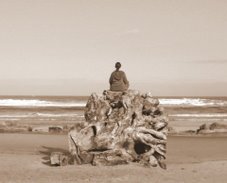
like someone
in a foreign land
with a daypack
of only your own
provincial tongue.
Poems are meant
to speak in metaphor,
but this is your truth,
your horrifying truth.
I know you
only so much.
Even so,
this much I know:
Every atom of oxygen
you would have forgone;
deeply into alien earth
you would have sunk;
a ravage of tears
you did, indeed, weep.
All to keep
her breathing,
all to keep
her here.
(cc) Karen G. Johnston
Showing posts with label Witness. Show all posts
Showing posts with label Witness. Show all posts
Friday, December 16, 2011


Monday, August 15, 2011
Makaila, Too
Water! Mama got water!
His finger points to her cheek,
his arms, legs nest themselves
where she is bent over in the chair.
He cannot look at her long,
but he gives what he has,
a body when she is sad.
Why gurgles from her mouth,
thudding at her feet
with the sound of again.
Little sister has entangled her limbs
in the lap of a kind stranger.
She has done every task we asked,
or not, without a single glance at our faces.
I follow the rules, remind this mother
in her florid despair
we are no oracle of diagnosis.
But the fear she hoped
we would banish with our bag of toys
has become more real,
not less.
Yes, it is a shame
that this two-year-old refuses
all food from their homeland.
Sadly, this is not
her only turning away.
I leave them all:
first-born son
and now baby girl
in their own worlds
as their mother makes her way
in this new one.
(cc) Karen G. Johnston
His finger points to her cheek,
his arms, legs nest themselves
where she is bent over in the chair.
He cannot look at her long,
but he gives what he has,
a body when she is sad.
Why gurgles from her mouth,
thudding at her feet
with the sound of again.
Little sister has entangled her limbs
in the lap of a kind stranger.
She has done every task we asked,
or not, without a single glance at our faces.
I follow the rules, remind this mother
in her florid despair
we are no oracle of diagnosis.
But the fear she hoped
we would banish with our bag of toys
has become more real,
not less.
Yes, it is a shame
that this two-year-old refuses
all food from their homeland.
Sadly, this is not
her only turning away.
I leave them all:
first-born son
and now baby girl
in their own worlds
as their mother makes her way
in this new one.
(cc) Karen G. Johnston
Sunday, October 24, 2010
Breaking the Rules of Polite Company
A giggle, so innocent
at your own social impropriety.
Giggle because you have called
yourself great, aloud.
You remember only just after
that there are rules about such things,
that we are not supposed to say
these thoughts aloud.
You correct your self-referential self,
“More true would be to say Alice thinks she’s great.”
I ask your age –
another breaking of social etiquette.
You tell me two possibilities,
plus the year of your birth,
which coincides with neither.
I say, aloud,
“Even more accurate would be that Karen thinks Alice is great.”
This delights you.
You giggle anew,
the girl you once were,
eight decades ago,
sitting beside me
when we arrive
at your destination.
(cc) Karen G. Johnston
at your own social impropriety.
Giggle because you have called
yourself great, aloud.
You remember only just after
that there are rules about such things,
that we are not supposed to say
these thoughts aloud.
You correct your self-referential self,
“More true would be to say Alice thinks she’s great.”
I ask your age –
another breaking of social etiquette.
You tell me two possibilities,
plus the year of your birth,
which coincides with neither.
I say, aloud,
“Even more accurate would be that Karen thinks Alice is great.”
This delights you.
You giggle anew,
the girl you once were,
eight decades ago,
sitting beside me
when we arrive
at your destination.
(cc) Karen G. Johnston
Vanishing Alice
These times
I am only what
we are together.
I am not
your daughter’s beloved friend
granddaughter’s mentor
your occasional preacher.
I am
car ride,
driver from one place to the next,
possibility of conversation.
I am
undemanding attention,
delight in the you of you.
And when
I drop you off,
at the place
of your arrival,
I am
no longer.
(cc) Karen G. Johnston
I am only what
we are together.
I am not
your daughter’s beloved friend
granddaughter’s mentor
your occasional preacher.
I am
car ride,
driver from one place to the next,
possibility of conversation.
I am
undemanding attention,
delight in the you of you.
And when
I drop you off,
at the place
of your arrival,
I am
no longer.
(cc) Karen G. Johnston
Saturday, October 16, 2010
Let the Foul Harpies Starve
The Harpies, feeding then upon its leaves,
Do pain create, and for the pain an outlet.
(H.W. Longfellow’s translation of
Dante’s Divine Comedy, Inferno, Canto XIII)
May their incessant
appetite remain unsated,
let them be sickened
at first taste,
let their feet catch fire
should they try to land
on the hearth
of your branches.
Let them find
sustenance elsewhere.
Perhaps among those
who damned you
without ever meeting you,
who taunted you
from afar and
to your face,
those who denounced you
before you were even born.
This knotting and twisting
we inflicted upon you
in this worldly hell,
forced within narrow confines
of who should love whom,
may it have ended the moment
you took your own life.
May you find the friends,
the allies, even the foes,
who know your true light,
and reflect it,
bright, shining,
blinding.
May you find
not only the peace,
we could somehow
not afford you,
not only the justice
we denied you,
but the loving lover
meant just for you,
meant to make you
laugh ‘til you cry
and when you are crying,
make you laugh belly-busting
hiccupping guffaws.
May you find that lover
meant to hold you,
to embrace the all of you,
the whole of you,
and most assuredly,
the queer of you.
Karen G. Johnston
Do pain create, and for the pain an outlet.
(H.W. Longfellow’s translation of
Dante’s Divine Comedy, Inferno, Canto XIII)
May their incessant
appetite remain unsated,
let them be sickened
at first taste,
let their feet catch fire
should they try to land
on the hearth
of your branches.
Let them find
sustenance elsewhere.
Perhaps among those
who damned you
without ever meeting you,
who taunted you
from afar and
to your face,
those who denounced you
before you were even born.
This knotting and twisting
we inflicted upon you
in this worldly hell,
forced within narrow confines
of who should love whom,
may it have ended the moment
you took your own life.
May you find the friends,
the allies, even the foes,
who know your true light,
and reflect it,
bright, shining,
blinding.
May you find
not only the peace,
we could somehow
not afford you,
not only the justice
we denied you,
but the loving lover
meant just for you,
meant to make you
laugh ‘til you cry
and when you are crying,
make you laugh belly-busting
hiccupping guffaws.
May you find that lover
meant to hold you,
to embrace the all of you,
the whole of you,
and most assuredly,
the queer of you.
Karen G. Johnston
Sunday, January 24, 2010
Vanishing Alice
I stand before her, talking pleasantries.
She does not recognize me.
She once sought out my poetic craft.
She once knew me as her daughter’s dear friend.
She once could place me without any effort.
No more.
(cc) Karen G. Johnston
She does not recognize me.
She once sought out my poetic craft.
She once knew me as her daughter’s dear friend.
She once could place me without any effort.
No more.
(cc) Karen G. Johnston
Sunday, September 20, 2009
Our Own Potter's Field
Thick scaly bark, these trees are old.
Impossible to know just how old,
since yew boughs hollow as they age.
Three make a canopy of bright berries,
crimson constellations suspended overhead.
As guides, these stars aren’t much use.
All parts of the plant are so poisonous,
save the dark seed within each red star,
that after ingestion, symptoms leading to death ~
staggering gait, muscle tremors, spasms ~
are often missed before terminal collapse.
Horses are most vulnerable, none but birds are safe.
Next to me, the cold bench memorializes
the burial ground this serene hillside might be.
I can’t help but wonder about the dying patients
from the State Lunatic Hospital at Northampton.
No rapid onset: only slow convulsed demise, largely unnoted.
Just a few days ago, I marveled at how the next field over
used to hold an abundance of pumpkins in September,
then late October, a bevy of children learning
the fine art of New England gleaning.
How one year there was a ragged La-Z-Boy ~
some collegiate prank or attempted performance art.
Around here, you can never be sure.
Now the meadow rolls, four shades
of green, one dappled lavender.
Some will not even consider purchase of a house
on the village hill two over from this one.
The collisions of beleaguered spirits too much
for the harmony of hearth and home.
Unsure if this is meditation or lamentation,
I set down novice feet, one after the other.
Heel, ball, toe. H e e l, b a l l, t o e.
Underneath: collapsed dirt has wended its way
from bone to soil, sinew to loam, flesh to earth.
I wonder how to make luminous these toxic rubies:
those just over my head in the sentinel trees,
those deep below my feet in each and every unmarked grave.
(cc) Karen G. Johnston
Impossible to know just how old,
since yew boughs hollow as they age.
Three make a canopy of bright berries,
crimson constellations suspended overhead.
As guides, these stars aren’t much use.
All parts of the plant are so poisonous,
save the dark seed within each red star,
that after ingestion, symptoms leading to death ~
staggering gait, muscle tremors, spasms ~
are often missed before terminal collapse.
Horses are most vulnerable, none but birds are safe.
Next to me, the cold bench memorializes
the burial ground this serene hillside might be.
I can’t help but wonder about the dying patients
from the State Lunatic Hospital at Northampton.
No rapid onset: only slow convulsed demise, largely unnoted.
Just a few days ago, I marveled at how the next field over
used to hold an abundance of pumpkins in September,
then late October, a bevy of children learning
the fine art of New England gleaning.
How one year there was a ragged La-Z-Boy ~
some collegiate prank or attempted performance art.
Around here, you can never be sure.
Now the meadow rolls, four shades
of green, one dappled lavender.
Some will not even consider purchase of a house
on the village hill two over from this one.
The collisions of beleaguered spirits too much
for the harmony of hearth and home.
Unsure if this is meditation or lamentation,
I set down novice feet, one after the other.
Heel, ball, toe. H e e l, b a l l, t o e.
Underneath: collapsed dirt has wended its way
from bone to soil, sinew to loam, flesh to earth.
I wonder how to make luminous these toxic rubies:
those just over my head in the sentinel trees,
those deep below my feet in each and every unmarked grave.
(cc) Karen G. Johnston
Tuesday, May 27, 2008
Dead Beneath his Rescue
Dispatcher voice becomes
cold blood, sweat, then pulse.
Sending him too close to home.
He pounds his father’s chest.
Inexplicably, his arms lengthen.
He is cartoon, the lop-headed drawing of himself
and the small Saturday-morning boy, jaw agape
at the doomed hijinx on the screen.
He is both compromised tether
and hard ball that rings the rusted pole,
wound ever tighter. Cut. Burn.
His force is certain, striking,…impotent.
Once he had been tremulous infant
in the arms of that crumpled man:
musk offering solace so deep
there was not even language,
just coo sinking into sinuous arms.
How dare the heavens demand this of him?
Heart chamber, now blue sanguine swell.
Broken ribs to brittle in furnace.
His own flesh, dead beneath his rescue.
cold blood, sweat, then pulse.
Sending him too close to home.
He pounds his father’s chest.
Inexplicably, his arms lengthen.
He is cartoon, the lop-headed drawing of himself
and the small Saturday-morning boy, jaw agape
at the doomed hijinx on the screen.
He is both compromised tether
and hard ball that rings the rusted pole,
wound ever tighter. Cut. Burn.
His force is certain, striking,…impotent.
Once he had been tremulous infant
in the arms of that crumpled man:
musk offering solace so deep
there was not even language,
just coo sinking into sinuous arms.
How dare the heavens demand this of him?
Heart chamber, now blue sanguine swell.
Broken ribs to brittle in furnace.
His own flesh, dead beneath his rescue.
(cc) Karen G. Johnston
Friday, April 4, 2008
Thursday, March 6, 2008
Narrative of a Friendship Late in One Life
Today marks the yahrzeit of John Brentlinger. One year ago today he died. One year ago yesterday I said good-bye through his comatose haze. I do not know the Mourner's Kaddish, but today I wish I did.
One says metta for all sentient beings. Can one say it for a someone who has died?
This compilation is a series of "letters" I wrote to John as our friendship began to take root. I never sent them to him. Something about the friendship between us inspired writing of all sorts: these "letters," a series of poems (a few of which John was aware of). It seemed a fitting way to mark this day by posting this.
One says metta for all sentient beings. Can one say it for a someone who has died?
John, may you be safe and protected. May you be peaceful and happy. May you be healthy and strong. May you have ease of well-being and accept the conditions of the world.
This compilation is a series of "letters" I wrote to John as our friendship began to take root. I never sent them to him. Something about the friendship between us inspired writing of all sorts: these "letters," a series of poems (a few of which John was aware of). It seemed a fitting way to mark this day by posting this.
Narrative of a Friendship Late in One Life
Diagnosis & Response
When I first read about your diagnosis in the church newsletter, I cried. For several days, not constantly, but each time I sat to meditate, each time some stillness entered my life. I did not know you – still do not – in the sense we had never spent time together, hardly exchanged words in person, and yet we knew that we orbited the same precious atmosphere. How is it that we knew this? It remains a mystery to me when I try to put words to it, though inside of me, it makes perfect sense.
So I cried, sometimes small tears, at least once weeping that brings on a rocking back and forth that I do to try to self-soothe. As I remember that particular rocking, I can still see the late spring light coming through the attic window. I see that light and myself rocking, but can’t quite feel it. Makes it sound disembodied but I was not. Maybe just the memory is.
I cried for you, because lung cancer is such a scary phrase. All couplings of words that end in “cancer” live on the continuum of doom, but I think those that start with “lung” and “ovarian” have a special place. An infamous place.
And I cried for me because, it turned out, I had a story line running in my head about how our lives would meander together at some point in the future, that it would happen of its own accord, because we had found we were kindred spirits. It would just happen and I didn’t need to make it happen. And as one of my spiritual tasks is to live into letting things happen, rather than making them happen, I thought I was doing the right thing.
But here was this diagnosis and my chance to “let” it happen was being stolen – really it felt like the chance for any friendship was being stolen, decimated. I felt robbed – which goes to show how self-centered I am, that I hear about a cancer diagnosis in another person and I feel robbed.
I think it was one of those moments, in front of my altar when the idea came to me. I might lose the chance for a friendship, but not the opportunity to connect to this precious gem of a man and to offer some light in a time likely dark and heavy for this family. I decided that I would write out quotes and poems and stories and send them, send a plethora of them, send them written and printed on bright colored paper, not send them all at once, but send them daily, so that there was this sense of abundance, perhaps a joyful anticipation each day that mail arrived at your house.
I am so glad that these gems have not only brought you light (in the form of laughter and reflection), but also that it has brought us together and resulted in our date for coffee later this morning.
Maybe Early October
I saw you in between services, waited (not really patiently) as you spoke with Brenda. I just wanted to say hello, because when I see you, I light up (I think it must be visible on the outside) and though I didn’t have anything in particular to say to you, I wanted to say hello. I just wanted to be closer to your orbit. I waited patiently, I’m not even sure you knew I was standing there as long as I did. Then you interrupted your talking with Brenda, you turned and said, pointing to me as if to introduce me, “This is one of my angels.”
You couldn’t have made me happier in that moment. I mentioned to you that in a few weeks that I would be doing a sermon and I hoped you would make a point to come. You said you would.
I wanted you to come because I felt inspired by you, by who I thought you were, and by your sermon on traveling. And once the sermon was nearly finished, it turned out that you lived in several places in the sermon I had just been writing. At first, the sermon seemed to want to be about the difference between helping professions and activism, but too much judgment came out in between each line. Thankfully, the sermon found its true message – not all writing does. As I’m sure you know.
A Sermon with Feet
It was a good sermon – good in content, good in delivery. As I am finding, now that I have given more than a few sermons, people want to share with you how they were moved or, sometimes, offer unsolicited advice. This aspect of sermon giving is a double edged sword for me, one that leaves me uncomfortable. I understand and want to feed that dynamic of being moved by someone’s words, of sparking off them, of expressing gratitude. I feel a bit uncomfortable being the focus of that gratitude, both because I feel modest and because I hunger a little too much for the compliments. Anyway, I am curious about how my words move people, so I listen to what people are willing to share with me.
There were two positive comments that stood out for me:
“A thing happens to women in our 40s. Our voices get stronger. Your voice was strong in this sermon, even stronger than just last year, when you gave your first sermon.”
“You really get him.”
The former is from an older (well, to me, she is older; to you, she is younger) long-standing member of the congregation. It was kind and unexpected.
The latter was also unexpected and filled me with great joy. Isn’t it wondrous that just four words can do that? As you know, the second comment was from your wife. Even now, it makes me so happy. I could spend the time in figuring it out – but I think I won’t. I’ll just let it be.
Make, not Let
At one point, I sent you an email and said that I would love to get together with you sometime for coffee or conversation. I felt hesitant, not wanting to intrude in your life, knowing you were tired and likely busy with all the things attendant to having lung cancer and seeking recovery.
You responded somewhat strangely, perhaps vaguely and the date I proposed didn’t seem to work for you. I took this as a clue that I shouldn’t pursue it too strongly. I let it go.
Then at the sermon on Sunday, you said, “Let’s find that time to get together.” That opened the door for me. But do you know what pushed me through? The source of my current romantic confusion/heartache – David. He is a computational biologist who is currently working at MIT on cures for childhood leukemia. I have told him about you, about my connection to you, about the spiritual meaning it holds for me. I do not know if he knows this because of his work, or from the time he once volunteered for hospice, but when I said that your doctors are so impressed with your recovery, he didn’t seem convinced. He said, “Lung cancer doesn’t have a cure. It’s mostly 6 -12 months from diagnosis, a few who make it a couple of years. But there are always those one or two who recover and for no reason we can figure out. And that always gives hope.” His tone made it sound like a fool’s hope, but true nonetheless.
I knew that I had to make a date for coffee with you then and there. I emailed you that evening and when I didn’t get a response, I called you a few days later on the phone.
Our First Coffee Date
What can I say about this luscious 80 minutes with a near stranger who couldn’t be more familiar? How thankful I am that you had the energy to drive, to sit and stay awake in our local vegan coffee house! How you made this effort for me, to be lucid, to take on meeting a new person who was, as far as you were concerned, known to you already. What have you seen in me to make it worth your while, your heavy effort?
Maybe it was easier because it wasn’t meeting someone new. It was renewing an old acquaintance. I’m not a believer in past lives, but maybe we share some energy from the same approximate region of Emerson’s Oversoul.
I like that idea.
The flow of conversation – even with your hesitations and attempts to mask memory gaps – was fluid and reassuring and striking and sonorous. Why is it I felt at such ease? Why did I want to share bits of each part of my life? Delivered two of my poems for you. (And gratefully accepted your single critique, which voiced the only discomfort I had with a line in the poem. It is changed now and each time I say that line, you are there.) Told you of my latest romantic quagmire. Drew you out, getting to hear stories of your quarter century of trips back and forth to
Your question of me about politics – I didn’t get it at first. I got stuck on it being so close to the November election. I wanted you to think I was radical, not some soft liberal, so I voiced my blasé opinion that it wouldn’t matter if the Dems took Congress. But you didn’t want to know my analysis of encroaching fascism (I said it like I had been the first to name it – I am amazed and embarrassed by my arrogance).
No, you wanted to hear the story of how my 10 year-old daughter sees sexism and racism and privilege in advertising and questions it, because politics is personal and deep and that’s how I’ve raised her. I had trouble telling the story to you because it’s so deep, I forget it’s there. Deep. Organic.
Like I think you live your flawed life. Like I live my flawed life.
And that was our first date. Let us hope it is not our last.
Hatless Courage
I think you came to the poetry service that I co-led over Labor Day weekend. I didn’t read any of my own poetry, but I read aloud the poetry of some wonderful others. The theme was Love, but not sappy love. It was called after a line in one of Adrienne Rich’s poems: “toward a new kind of love your life has never allowed“.
I think it was at this service that I saw you take off your hat, show your bald head. I was embarrassed how, earlier, before I knew of your diagnosis, I had mentioned that you had your hat on, you took it off, and your shock of white hair was gone. I didn’t know what to say. I wonder what I did say, if you remember my reaction, which was probably not especially graceful. I fear it might have been “John, your beautiful hair is gone!” like my appreciation to your hair was the center of importance. I wonder how many times you encountered – still encounter – reactions like that. Not unkind reactions, but ignorant ones. Because at that point, I didn’t know about the cancer and didn’t guess it either.
Anyway, it was after that I heard about your diagnosis, understood what had happened to your hair, and cringed in self-recrimination.
Then there you were, as I read poetry about Love, and your hat was off as you sat in the pew and I felt such love for you and your courage to sit hatless in our holy house. I think I wrote you a card and told you so. A card (I hope) or an email (at least). I hope it emboldened you.
Thirty-three Years Difference
Thank god you are as old as you are. If you were thirty years younger (or even 20, given my proclivities) I would have a wicked crush on you. And that would mess things up, I’m pretty darn sure of it.
Be as Miserable as You Are
I haven’t seen you around much and though that’s not so unusual, I sensed something was up. I don’t really have a true sixth sense, the way my friend Hanneli does, some kind of special key to a different plane of existence. So when I get one of those feelings, like I know something that isn’t rationally knowable, it’s usually just a sublimated wish. Like the thousands of times I have become smitten with someone and said, “Oh, he’s the one…” Wrong. Just wishful.
But I called you tonight, which felt forward, fearing intrusive. I called, put on a casual voice like it was okay to be calling. Asked, “Is John around?” when
I ask, “How are you?” and you say, well, it’s a long question. Then you say, it’s a short question with a long answer. I already knew, even before the how are you, it wasn’t good news. How could it be? Yet I feel like a bubble has burst, the one you have tried so hard to inflate around you and all who are near you: the bubble that you might be able to lick this thing that really no one licks, just endures.
You say you are fatigued. I know there is more. Do I wait for you to tell me or do I ask? I should wait, this is your life, this is your death, but I can’t. I don’t feel like it. I ask why, I ask if you know why you are so fatigued. And when I do, it’s not me setting the pace and you being dragged along. It’s our pace and so we talk.
The damn thing has invaded your spine. Two weeks ago you found out. New course of radiation. Trips to
You apologize for being the bearer of bad news. I chide you for such a worry. I understand that perverse dynamic: the sick, who are living it, become caretakers of those who must only listen to the news. It has the potential to be transformative, but too often it is a burden and is tiresome, spiritually and physically. I do not want to be this kind of person in your life.
You are tired. Friends are taking care of you. Food is taken care of. You are trying to read and rest. The bed is now downstairs. A sure sign, no doubt not lost on you, but is it spoken aloud? Dare I say it? And the point would be?
My offer of food declined, I say stalwartly that I will re-up my letters. I say you can read them if you are inclined, disregard them if you so choose. Sweetly, and truthfully, you say you are always inclined to read my letters. If we had been in the same room, I would have blushed.
You say I am welcome to drop by. Really? I am so pleased at the invitation. I say, I will come on Friday. That I don’t care how miserable you are, you needn’t put up a show for me or apologize for having bad news. You can be as miserable as you like, I wouldn’t have it any other way, or else I won’t come. You laugh, but there isn’t much umph in it. That’s okay. Sad, but okay.
So I will see you in a few days, man who has become this dear friend.
Driving on Interstate 95
I sent you new notes with new quotes on vibrant paper, planning to visit you a few days later on Friday. Inbetween, a few days away with my kids – off to Mystic,
Already dark, we were heading to friends to have dinner at their home. All I could do was drive on, keep one hand on the wheel and use the other to write what I hoped was legible scrawl of words that might become lines sometime. It’s actually something I’ve become decent at, was inspired to perfect after reading a wonderful poem about the very act of writing in the dark so as not to lose a dream image.
And so in a state where it is not legal to drive while talking on your cell phone without a headset, I paid attention to the letter of the law, not the spirit. And wrote. Wrote legibly. Wrote legibly about you. Wrote about you and this latest cancer. This one in your spine. This malignant lace.
Memento Mori
I am unsure. How to go about this death thing has me a bit stymied. I have always, as long as I can remember, been at ease talking about death. Long before I began working with kids with murdered parents, dead parents, grieving living parents. Before two of my clients in the homeless shelter died. One, an overdose of heroin. One, frozen to death on the sidewalk under the watchful, and inept, window of the Department of Housing and Urban Development. Long before my two uncles suicided, one by shotgun and one by yet another drug overdose.
It just doesn’t scare me. Which is to say, it does scare me, but not talking about it scares me more, makes me more uncomfortable, makes me ill-at-ease, makes me feel as if I am being complicit with some dangerous secret.
I grew up with enough of those that I try to steer clear.
So I wonder what it will be like if I send this latest quote to you, this one from Alice Walker’s “Living by the Word.” Will it feel like I am not being the good cheerleader that everyone is supposed to be, rallying behind life in the face of overwhelming odds? (And then shunned, kept out, because I didn’t play along, didn’t play by the rules?)
Or will it be a sweet release, the festering sore let free of its insidious pus, painful, but relieving? The truth spoken, unafraid, named and therefore, not so threatening, not so menacing?
Or will I join a hearty (perhaps even brazen) company of men and women already sharing your orbit, already conversant in substantial care of you? Good people already fluent in Memento Mori : “the constant awareness of death; acceptance of mortality and dedication to life regardless”
May it be so.
Three Newspapers
How can such ordinary objects hold such sinister anticipation? In conversation with a mutual friend, who knows you a little less than I do but whose partner knows you much better, I hear that he tried to call you yesterday, that your voice mail was full. He did not know of the latest occurrence and so I told him. Him, whose own mother has been battling cancer for three years and is hosting dinner parties, from whom he just returned after a holiday in Florida with this new partner, his fiancée, who met you years ago in Nicaragua and is on her way there now.
Like you are supposed to be. Going to
So I went by today. Had planned to go yesterday but it didn’t work out. Went by expecting (hoping?) to see you, not really giving much attention to the comment about full voice mail.
When I arrived, there were three newspapers in the box. Four days’ worth. No mail in the letterbox, but that’s not a surprise. No mail in three days due to a planned holiday (New Year’s Day) and an unexpected (in my opinion, unwarranted) one to mark Gerald Ford’s funeral.
I knocked. No answer. No car in the driveway. I pushed at the knob; the door opened. It does not surprise me that you leave your home open. I called out your names: “John?
I brought in three now-sinister newspapers, left them on your couch. A note in my handwriting, with my name and number at the bottom, perch atop, wondering what comes next.
Friday, January 25, 2008
Honey Creeps
I can’t stop asking friends, acquaintances,
strangers in line at the grocery store,
but nobody seems to know the answer.
I might have to wait until spring,
when the farmers market unfurls its umbrella
of vegetable seedlings, cage-free eggs
on the tarmac behind the library.
It’s possible I’ll never know.
Maybe I’ll ask the guy who sold me
this hefty six pound jar of sugary, thick sunshine.
It’s possible he’ll know, but there’s no guarantee.
He’s just a beekeeper and strawberry grower,
awkward, not the easiest guy to talk to.
I may never figure it out.
Just because he gathered the honey
doesn’t mean he’ll be able to explain the physics
of why each night, despite my careful wiping away
of the day’s residue, it creeps up the inside walls
of the glass jar, how it insinuates itself between
glass rim and tin lid, each morning irksome glue,
each morning making me work just a bit harder
for the perfection in my oversized mug:
black
Like I doubt he – or anybody –
can explain to me why they sent her away,
14-year-old mother of one-year-old Sylvie
not the handsome, sweet-talking older cousin
who’d been pimping her for years.
The poet Rumi exhorts “don’t be the jar of water whose rim always stays dry.”
He wasn’t thinking of the slow upward sneak of honey.
He was thinking abundance, as in my cup runneth over!
He was thinking generosity, as in what’s mine is yours!
He wasn’t thinking they’d take his side, not hers.
Friday, January 18, 2008
Spare Nest
(Part I)
Lost in the neighborhood grocery store,
adoring husband of 35 years only ten feet away,
but not the five she required
to recognize her place in the world.
Her panic rising, next to her
beloved daughter no longer
familiar point of reference,
now one of the swarming mass of humanity
who terrorizes with disturbing strangeness.
(Part II)
Have you ever seen the hole a lit cigarette makes when pressed to unfolded rolling paper? Just at first, it is the exact size of the round embered tip. Then it grows, orange hair-line trim expanding the circumference unevenly, persistently, burning away the once-wood pulp, once-virgin forest, forever.
Lack of word retrieval, inability to recall unimportant facts. Then important facts, difficulty following multi-step tasks, like baking her fabled pound cake. Then as simple as boiling water or remembering that one must turn off the stove burner after one turns it on. Refined rolling paper, wood pulp, virgin forest: clear-cut, slash and burn, it does not matter.
(Part III)
No discernible intellect to sculpt
her animal essence, she had become
a spare nest of primitive emotion.
Hollowed, howling, haunted.
Ragged, roughened, ravaged.
Unrecognizing, unrecognizable.
No beauty transcending cruelty.
No reassurance to offer
nor metaphor to distill.
Just the harsh, relentless fact
that her body remained
too many years in ruthless bed.
is
all.
These pitiful words
are all I have
to offer.
So tiny
that infinite amounts
(nothing)
fit in the palm of my hand.
Open or closed,
it does not matter.
Thursday, January 10, 2008
You Don't Write in Winter
The sorry excuse of a lamp sputters light
in the grey heft of the season’s air.
The daylight is too thin, your tongue too swollen.
Shoveling snow fatigues the muscles in both shoulders
encroaching upon your hand whether it types
or cradles a pen or wipes the steady train
streaking your cheeks, common jewels
glistening the length of your stubbled neck.
Your fingers bleed, but not all the way through
the interspersed bandages that fray as you split wood,
slip loose as you wash dishes.
Poets & therapists & the old guy
at the package store at Oak & Harlow,
they’re always looking for some word,
or phrase that gives it a better name.
A stronger name. One worthy of its might.
They say it is
walking amid molasses,
a recklessly-weighted hibernation,
an acrid sink hole.
All of that is cliché, old hat,
is been-there, done-that.
Still, how many times have you wished
for the reprieve a sink hole might offer?
A chance to descend into silent sigh,
no tether, no miracle ledge to catch you.
To sink, sink, sink
into something other
than this abrupt halt,
this cold metal curse,
this twisting stucco
taloned with unintention
that shreds tender fingers
offering to stroke its texture,
while insipid lamplight disperses only trivial shadows.
(cc) Karen G. Johnston
Monday, October 8, 2007
The Question
When his lithe
teen-aged daughter,
knocked on the door,
on the bolted door,
knocked to say hello,
was he alive?
Was he alive
when she shook the brass knob,
smudged with desperate sweat,
his volatile absence,
as she shook the brass knob
hollow, then heavy in her hand?
Like his older brother,
ten years before.
Just like him,
three daughters,
one and then two
in close succession.
Both men:
failed farmer,
lost land,
gone generations.
Yet not exactly alike:
not the shotgun
his big brother used.
Not how it rang out
in front of family,
abrupt ringing indictment.
Unlike his elder brother’s,
his was prolonged:
addict’s swollen face,
years of slow decay,
next chronic away,
then lonely chemical gone.
Let us tell her
he had already been long dead,
whether we know it or not.
Let us tell her
there was nothing
she could have done.
As we tell ourselves,
there was nothing
any of us
could have done.
(cc) Karen G. Johnston
Monday, September 10, 2007
I Had Decided Against Telling Saying Her Hair Is Beautiful
Tight corkscrews of shaved silver.
Twisted gray clay.
Thick cloud of black wool.
A mottled, muddled melange.
I had wanted to tell her
how it suits her round face
how it makes me happy
how it shouts she is here.
When my sandwich is ready,
she hands it across the counter.
I change my mind. I tell her.
I tell her because it’s true.
I tell her because
I want to make her happy.
Tell her because
I want her to go home,
be enfolded in her lover’s arms,
and when asked how her day was,
I want her to say my hair was beautiful.
I think I am giving her a gift,
a small pleasure. Some unexpected joy
when minimum wage doesn’t offer too much of that.
She smiles.
I think her smile is the gift
I will go home with,
the one I will tell my children
at the dinner table
when we say how our day was.
I will tell them how
I made a stranger smile.
I will tell them how
I made a stranger
with beautiful hair
smile.
It’s how it grew.
My face puzzles.
After the chemo.
And the radiation.
She shrugs.
It’s how it grew back.
When I ask her if she likes it,
her wider smile blesses us both.
Oh, yes.
(cc) Karen G. Johnston
Friday, September 7, 2007
Dance Gently, Vibrantly, then Bare Fruit
Even decent men feel diminished,
devise plots to ditch depressed wives,
…then don’t.
Good guys give into gall,
generate venom, temporarily viper,
…then beg forgiveness.
The best blokes battle with doubt,
banter & bluster, only to remain bound,
…not broken, but bountiful.
There are times when a fine fellow
will forgo all foundation, foster fiasco,
…then find his way forward.
(cc) Karen G. Johnston
Friday, July 6, 2007
Widower
Grey-muzzled dog sprawls on floor,
well-worn furniture, well-used mess.
All surfaces shrouded with books:
gnostic scriptures, Jesus, wild hope.
giving away early geography.
There is more in what he speaks.
It is how he says her name.
Over and over, again and again,
with such solid adoration,
such evocative presence.
Yet no wedding ring.
It is the stale air he breathes at his pillow,
the morning coffee he no longer makes.
It is the socks no longer twinned,
It is the specter of his gone father,
with all that he left unlived.
It is how their daughter grieves gracefully,
while he ambles in his awkward, intent way.
It is his own skin and his own bones
It is obvious now, how it hangs on him
like a mourner’s suit coat, wrinkled,
tight in the middle, sagging at the shoulder.
He will pack up this cluttered house and move away.
A full-time parish exchanged for a part-time country one.
It is the chance to realize one persistent dream
with the passing of one three decades long.
(cc) Karen G. Johnston
Tuesday, May 22, 2007
Sharp Shadows
I want desperately
to bathe you in Blessing,
in Light that disperses
these sharp shadows.
I wish I had the
Fundamentalist’s conviction,
finding sure measure
in your suffering.
A Pentecostal’s belief
in the ability to cast out
the devil afflicting you.
If it could make the difference,
I would devote myself
to Rigid Dogma:
Safe passage not only
for your corporeal self,
but your young soul.
It would become
my only dedication,
my only worship,
my only vocation.
I would have
no other gods,
no golden lamb,
no false idols.
I would not be this
helpless novice
blind mendicant
pseudo protector
mouthing promises of
keeping you safe.
Promises
only you
can keep.
(cc) Karen G. Johnston
Tuesday, May 15, 2007
A Man of Grand Stature is Gone
His wide-eyed granddaughter:
caramel skin, proper yellow dress,
first set of heels, just an inch
off the ground.
She sits in the front pew
with her worn grandmother:
now widow, wiry hair wild.
Arms wrapped around each other
for dear life.
Her gaze fixes on the bereft friend,
as she hears him call out her name.
Ten-year old eyes impossibly wider still.
In this sea of magnificent witness,
they exist only for each other.
He beseeches her to remember:
she nods earnestly. Over and over,
as he tells us what she meant
to her grand Papa.
Does she know to what she assents?
Not entirely, but she intuits.
Though partial, it is enough.
And perhaps better.
(cc) Karen G. Johnston
Saturday, April 21, 2007
Halibut Point State Park

 Journal Entry: April 21, 2007 2:40pm
Lost J. for 30-40 minutes. It was at Halibut Point, a deep quarry with high, sheer granite walls; the quarry abuts the ocean with rocks at the bottom with relatively calm surf, but powerful nonetheless.
It was increasingly harrowing, each passing minute, finishing the whole loop, expecting to see him just around the corner, but each time: not there. Not finding him at the car. Going back to the loop. No one was staffing the Visitor's Center, I carried no watch and had little sense of how much time had realistically passed. Asking passers-by if they had seen a boy with bleached hair and green t-shirt (all=no). Asking the last set with my heart in my throat, tears springing out despite my attempt all along to temper my fears, which M. took as my not caring that we couldn't find him and took me to task. Trying to remember that M. is just a little girl, with her own worries about her lost big brother while I was struggling with my own fears.
What had been beautiful felt all of a sudden dangerous. What had seemed a reasonable response to his angry sculking off became incrementally a neglectful, passive-aggressive reaction.
I was not sure how I would respond when we found him: angry acrimony or relief at his safety, empathy for his own fright that must be happening simultaneously. I feared the former, wished for the latter. I pretty much expected I'd be yelling at him, embarrasing myself and alienating him.
I practiced breathing. Tried a meditative stance: towards M's anxious prattle that increased as time went on and upped my stress level; towards the apocolyptic visions growing in my head of a drown boy or pedofile stranger whisking him away; towards what seemed like the only two options upon our (hopefully) eventual reunion.
Why do we fill Uncertainty with frightful ideas? Such poor design.
When I saw him -- thank God -- from afar, called out his sweet name, he came running. I jogged toward him, hugged him, buried my face in his dirty hair, started bawling. I said something about my relief at his being safe, kept sobbing. Then I sat on a rock nearby, sobbing, sobbing. He said something, I can't remember what it was now, and I replied, "I'm not the one who walked away in anger."
This, of course, triggered his guilt -- "Why do you always blame me!?!" -- and resulted in his spending the next half hour trying to bait me into arguments. It's so much easier to feel indignant than to feel badly. Especially if you are turning 13 next week.
So far, I've resisted. With admirable equinimity, I might add. Today I think I might have matured a bit: I know, deep in my heart of hearts, better than any artificial consequence I could create to soothe my wound at having been scared or to try to teach him about exercising better judgement when he takes space, the best teacher he got from this experience was seeing his mother sob uncontrollably without the distraction of anger.
I hope that vision is a worthy teacher for both of us for the rest of our lives.
Subscribe to:
Posts (Atom)

 Posts
Posts